A familiar scenario is playing out in many large organizations.
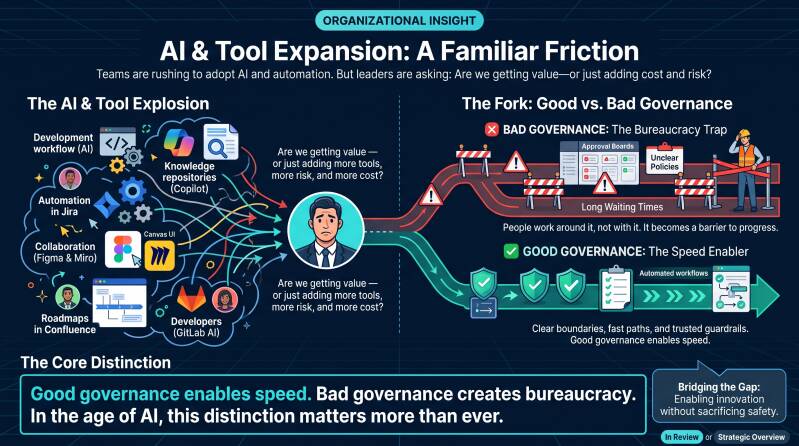
One team wants to activate AI in their development workflow. Another wants to connect Copilot to knowledge repositories. A third is experimenting with automation in Jira. Designers are using Figma and Miro to speed up collaboration. Product teams are building roadmaps in Confluence. Developers are looking at GitLab AI capabilities. Meanwhile, leaders are asking a very reasonable question:
Are we getting value from all of this — or are we just adding more tools, more risk, and more cost?
This is where governance enters the conversation.
Unfortunately, governance often arrives with a bad reputation. For many teams, it means delays, approval boards, unclear policies, and long waiting times. It becomes something people work around rather than something they work with.
But governance does not have to slow an organization down.
In fact, the right governance model should do the opposite.
Good governance enables speed. Bad governance creates bureaucracy.
And in the age of AI, this distinction matters more than ever.
The Real Problem Is Not Governance — It Is Bad Governance
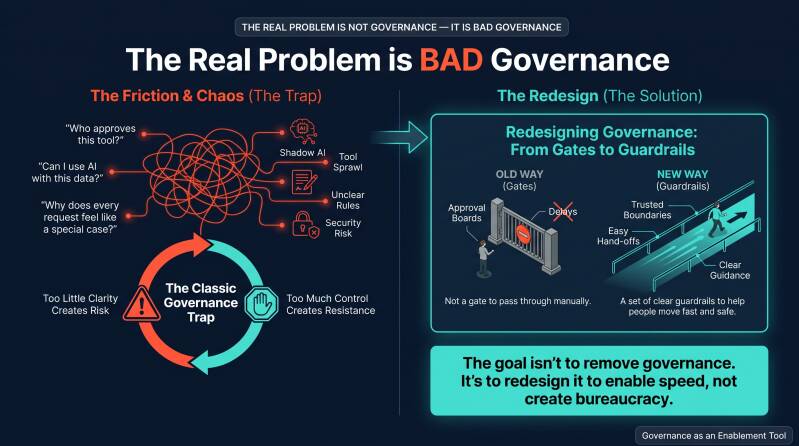
Most organizations do not suffer from too much governance. They suffer from governance that is too late, too vague, too disconnected from real workflows, or too focused on control instead of enablement. When governance is designed poorly, teams experience it as friction:
- “Who approves this tool?”
- “Can I use AI with this data?”
- “Why do some teams have access and others do not?”
- “Which platform should we use for this workflow?”
- “Is this a security issue, a compliance issue, or a budget issue?”
- “Why does every request feel like a special case?”
These questions slow people down because the rules are unclear. And when the rules are unclear, teams make their own. That is when tool sprawl grows. Shadow AI appears. Licenses are assigned without clear value. Platforms overlap. Sensitive data moves into places it should not. Workflows become fragmented. And eventually, leadership reacts by adding more restrictions. This creates the classic governance trap: Too little clarity creates risk. Too much control creates resistance. The answer is not to remove governance. The answer is to redesign it. Governance should not be a gate that every team must pass through manually. It should be a set of clear guardrails that help people make good decisions quickly.
Tool Sprawl Is a Portfolio Problem, Not a Tool Problem
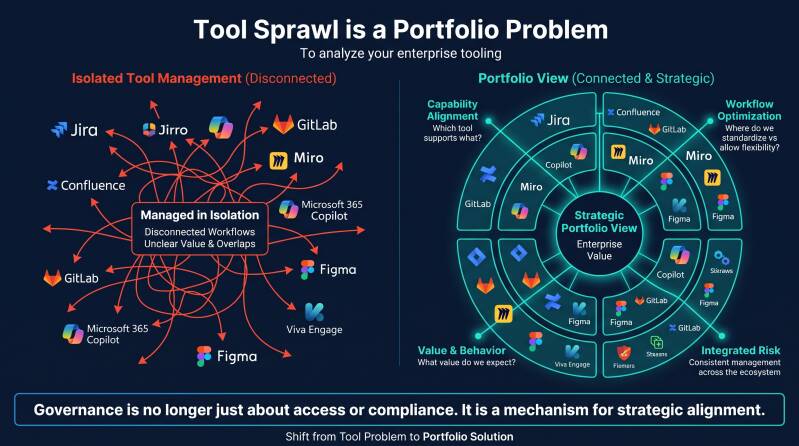
Enterprise tooling is rarely simple. A modern digital organization may rely on Jira for work management, Confluence for documentation, GitLab for software delivery, Miro for workshops, Figma for design collaboration, Microsoft 365 Copilot for productivity, and Viva Engage for community-driven learning. Each tool may be valuable on its own. But the enterprise problem is not whether each individual tool has value. The bigger question is: Does the overall tool ecosystem create value — or complexity? This is where product portfolio thinking becomes critical. If every platform is managed in isolation, decisions become fragmented:
- Jira is optimized for one team’s workflow, but not connected to portfolio reporting.
- Confluence becomes a knowledge base, but content quality varies widely.
- GitLab supports engineering delivery, but governance around access, groups, and AI features becomes inconsistent.
- Miro and Figma support collaboration, but ownership and lifecycle management are unclear.
- Copilot is rolled out to users, but there is no strong link between license allocation and measurable business value.
- Viva Engage becomes a communication channel, but not necessarily an adoption engine.
None of these are purely technical issues. They are portfolio issues. A portfolio view asks different questions:
- Which tools support which business capabilities?
- Where do workflows overlap?
- Where should we standardize?
- Where should we allow flexibility?
- Which tools are strategic, and which are supporting?
- What value do we expect from each platform?
- What behaviors do we need people to adopt?
- What risks must be managed consistently across the ecosystem?
This changes the role of governance. Governance is no longer just about access control or compliance. It becomes a mechanism for strategic alignment.
Adoption Is Not the Same as License Distribution
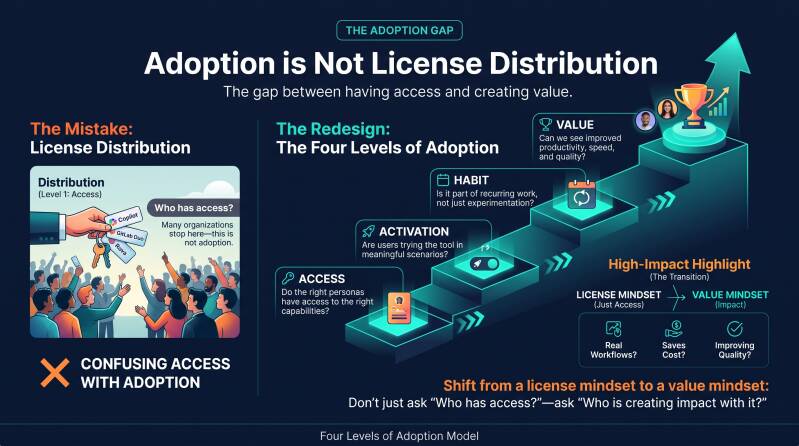
One of the biggest mistakes organizations make is confusing access with adoption. Giving someone a license does not mean they are using the tool effectively. This is especially true with AI. A user may have access to Copilot, GitLab Duo, Rovo, or another AI-enabled capability. But access alone does not answer the most important questions:
- Are they using it in real workflows?
- Are they using it safely?
- Are they using features that justify the cost?
- Has it changed how they work?
- Is it improving quality, speed, creativity, or decision-making?
- Are teams sharing what works?
- Are leaders removing blockers?
- Is the organization learning from adoption data?
This is where governance must shift from a license mindset to a value mindset. A license mindset asks: Who has access? A value mindset asks: Who is creating measurable impact with access? That does not mean every user must produce a perfect ROI calculation. But it does mean organizations need more discipline around how tools are introduced, supported, measured, and evolved. For AI-enabled tools, I would look at four levels of adoption:
1. Access
Do the right personas have access to the right capabilities?
2. Activation
Are users actually trying the tool in meaningful scenarios?
3. Habit Formation
Is the tool becoming part of recurring work, not just experimentation?
4. Value Realization
Can we see evidence of improved productivity, quality, decision-making, speed, or employee experience? Many organizations stop at level one. That is not adoption. That is distribution.
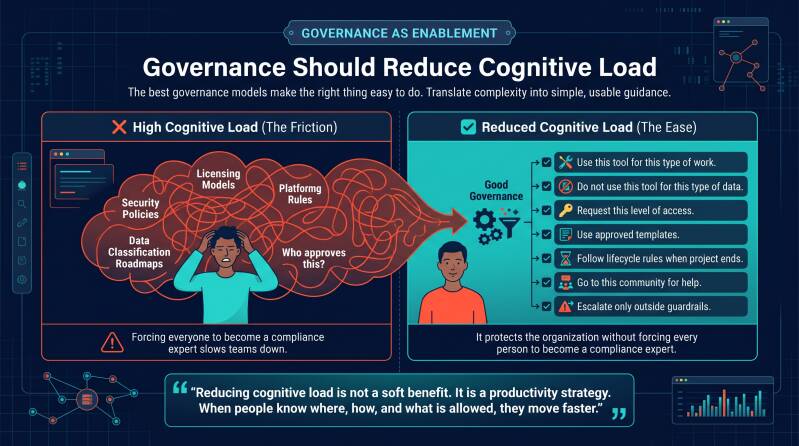
Governance Should Reduce Cognitive Load
The best governance models make the right thing easy to do. People should not need to understand every security policy, licensing model, data classification rule, and platform roadmap before they can make a sensible decision. That is the job of good governance: to translate complexity into simple, usable guidance. For example, instead of giving teams a long policy document and expecting them to interpret it, provide practical decision guidance:
- Use this tool for this type of work.
- Do not use this tool for this type of data.
- Request this level of access when your role requires these capabilities.
- Use approved templates for these workflows.
- Follow this lifecycle rule when a project ends.
- Go to this community when you need help.
- Escalate only when the use case falls outside defined guardrails.
This is governance as enablement. It reduces uncertainty. It prevents every team from reinventing decisions. It protects the organization without forcing every person to become a compliance expert. In a large enterprise, reducing cognitive load is not a soft benefit. It is a productivity strategy. When people know where to work, how to work, and what is allowed, they move faster.
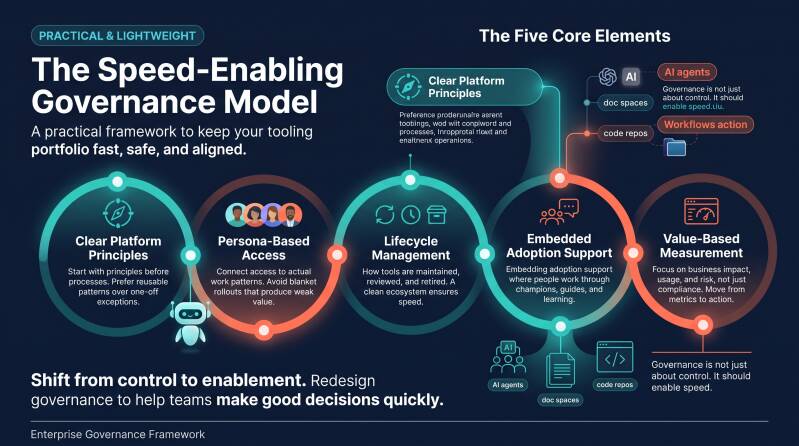
The Speed-Enabling Governance Model
If I were designing governance for an enterprise AI and collaboration tooling portfolio, I would keep it practical and lightweight. I would focus on five elements.
1. Clear Platform Principles
Start with principles before processes. Principles help teams make decisions even when the exact scenario is new. For example:
- We optimize for enterprise value, not local convenience.
- We standardize where consistency improves speed, security, or reporting.
- We allow flexibility where teams have genuinely different workflows.
- We assign licenses based on persona, use case, and expected value.
- We treat AI governance as part of everyday work, not a separate compliance exercise.
- We prefer reusable patterns over one-off exceptions.
Principles prevent governance from becoming a case-by-case negotiation. They also make leadership decisions more transparent.
2. Persona-Based Access
Role-based access is often too broad. Persona-based access is more useful because it connects tooling to actual work patterns. A finance analyst, software engineer, product manager, UX designer, people leader, and executive assistant may all benefit from AI — but not in the same way. The same applies to collaboration tools. A product manager may need Jira roadmaps, Confluence spaces, Miro boards, and Copilot for synthesis. A developer may need GitLab, Jira, Confluence, and AI-assisted code review. A designer may need Figma, Miro, Confluence, and structured feedback workflows. Persona-based governance asks:
- What work does this persona perform?
- Which tools are essential?
- Which AI capabilities create meaningful value?
- What data does this persona handle?
- What training or guidance is required?
- What risks are most relevant?
This creates a stronger link between access, adoption, cost, and impact. It also avoids blanket rollouts that look impressive on paper but produce weak value in practice.
3. Lifecycle Management
Most governance conversations focus on how tools are introduced. Not enough focus is placed on how tools are maintained, reviewed, cleaned up, and retired. Lifecycle management should answer:
- Who owns the platform?
- Who owns the roadmap?
- Who owns user access?
- Who reviews usage and value?
- When should inactive users be removed?
- When should spaces, boards, repositories, or projects be archived?
- When should integrations be reviewed?
- When should a tool be consolidated or retired?
Without lifecycle management, every tool becomes permanent. And when every tool becomes permanent, complexity becomes permanent too. Speed depends on a clean ecosystem. A cluttered platform landscape slows down onboarding, search, reporting, compliance, and decision-making.
4. Embedded Adoption Support
Governance cannot live only in policy documents. It must show up where people work. That means embedding adoption support into the ecosystem through:
- Champions and super-users
- Communities of practice
- Office hours
- Scenario-based learning
- Templates and examples
- Short practical guides
- Feedback loops
- Usage insights
- Leadership storytelling
This is especially important for AI adoption. People do not become confident AI users by reading a policy. They become confident by seeing practical examples, trying relevant prompts, learning from peers, and understanding safe boundaries. Tools like Viva Engage can play an important role here, not as a broadcast channel, but as a learning network. Confluence can become the structured knowledge base. Jira can capture improvement work. Miro can support collaborative learning sessions. GitLab can bring governance into engineering workflows. Copilot can help people synthesize, draft, and accelerate daily tasks. The point is not the tool itself. The point is that adoption support must be visible, accessible, and connected to real work.
5. Value-Based Measurement
Governance should not only measure compliance. It should measure whether the portfolio is creating value. That requires a balanced view of metrics:
Usage Metrics
Who is using the tool, how often, and in which workflows?
Adoption Metrics
Are users moving from experimentation to repeatable habits?
Business Impact Metrics
Is the tool improving cycle time, quality, decision-making, customer experience, or employee productivity?
Risk Metrics
Are users following security, privacy, and data handling expectations?
Portfolio Metrics
Are tools overlapping, underused, over-customized, or creating unnecessary complexity? The goal is not to create a reporting factory. The goal is to make better decisions. If a tool is strategic, invest in adoption.
If a tool is underused, understand why.
If a license is expensive but not creating value, reallocate it.
If teams are creating workarounds, fix the governance or the platform experience.
If a community is producing reusable patterns, scale them. Measurement should lead to action. Otherwise, it is just dashboard decoration.
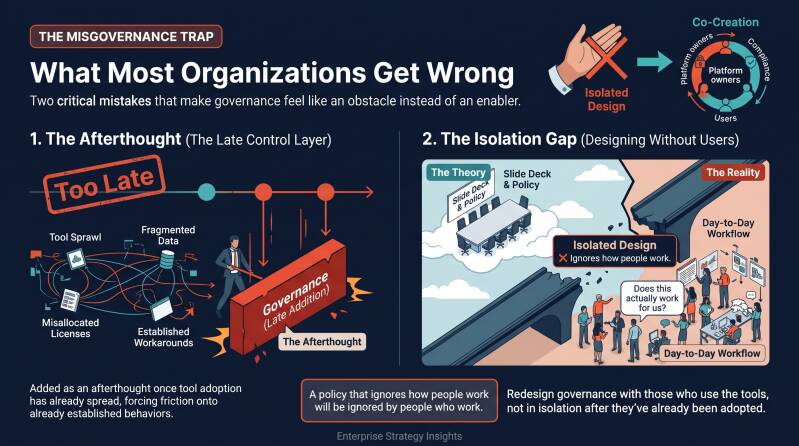
What Most Organizations Get Wrong
Many organizations approach governance as a control layer added after the tool has already spread. That is too late. By then, behaviors are already established. Teams have already created workarounds. Data may already be fragmented. Licenses may already be misallocated. Expectations may already be unclear. Another common mistake is designing governance without the people who use the tools every day. Governance created in isolation often looks clean in a slide deck but fails in real workflows. The best governance models are co-created with platform owners, security, compliance, business stakeholders, and actual users. That does not mean every decision becomes democratic. It means governance must be informed by reality. A policy that ignores how people work will be ignored by people who work.
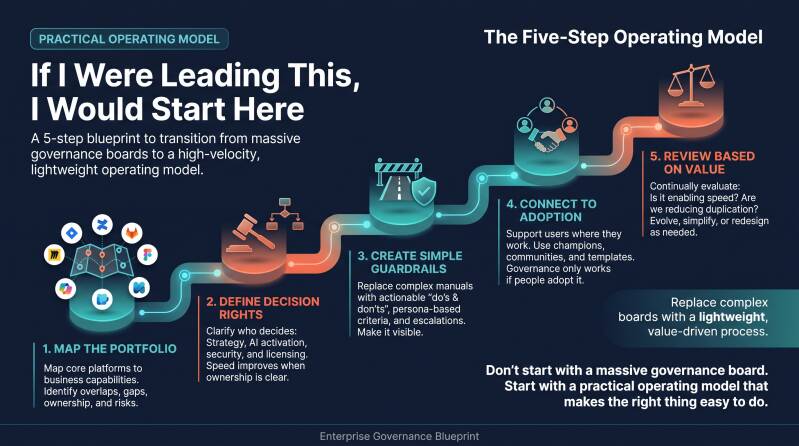
If I Were Leading This, I Would Start Here
If I were leading enterprise governance for AI and digital collaboration tools, I would not begin with a massive governance board. I would start with a practical operating model.
First, map the portfolio
List the core platforms and the business capabilities they support. For example:
- Jira: work management, delivery planning, portfolio visibility
- Confluence: knowledge management, documentation, decision records
- GitLab: software delivery, DevOps, engineering governance
- Miro: workshops, discovery, visual collaboration
- Figma: product design and design system collaboration
- Copilot: productivity, synthesis, content creation, AI-assisted work
- Viva Engage: community, peer learning, adoption storytelling
Then identify overlaps, gaps, ownership, risks, and strategic priorities.
Second, define decision rights
Clarify who decides:
- Platform strategy
- License allocation
- AI feature activation
- Security exceptions
- Integration approvals
- Data handling requirements
- Lifecycle rules
- Adoption priorities
Speed improves when decision rights are clear. People do not need every answer immediately. But they need to know who can make the decision.
Third, create simple guardrails
Avoid starting with a fifty-page governance manual. Start with practical guidance people can use:
- Approved tools by workflow
- AI usage do’s and don’ts
- Data sensitivity guidance
- Persona-based access criteria
- License request principles
- Community support channels
- Escalation paths
- Review cadence
Make it clear. Make it visible. Make it easy to follow.
Fourth, connect governance to adoption
Every governance decision should ask: How will users understand and adopt this? If the answer is “we will send an email,” that is usually not enough. Use communities, champions, enablement sessions, templates, short videos, and manager talking points. Governance only works when people can remember it, apply it, and see why it matters.
Fifth, review based on value
Governance should evolve. Review what is working and what is not. Ask:
- Are teams moving faster?
- Are users more confident?
- Are risks better managed?
- Are licenses aligned to value?
- Are workflows more consistent?
- Are platforms easier to navigate?
- Are we reducing duplication?
- Are we enabling innovation responsibly?
If governance is not improving these outcomes, it needs to be simplified or redesigned.
Governance as a Leadership Capability
In the AI era, governance is no longer just an IT responsibility. It is a leadership capability. Leaders must create environments where teams can experiment safely, adopt tools responsibly, and focus on outcomes instead of noise. That requires a different mindset. Not control for the sake of control.
Not speed at any cost.
Not innovation theater.
Not tool adoption as a vanity metric. The goal is responsible acceleration. The organizations that get this right will not be the ones with the most tools or the biggest AI announcements. They will be the ones that create clarity. Clarity about where to work.
Clarity about how to use AI safely.
Clarity about which tools matter.
Clarity about who decides.
Clarity about what value looks like. Because when people have clarity, they move faster. And when governance creates clarity, it stops being bureaucracy. It becomes a competitive advantage.

Conclusion
Enterprise governance needs a rebrand. It should not be seen as the department of “no.” It should be designed as the operating system for speed, trust, and scale. In a world where AI capabilities are expanding quickly, collaboration tools are multiplying, and digital work is increasingly distributed, organizations cannot rely on informal rules and heroic individuals. They need governance that enables good decisions at scale. The future belongs to organizations that can move fast without becoming reckless. And that starts with a simple leadership question: Are our guardrails helping people move — or are they making them wait?