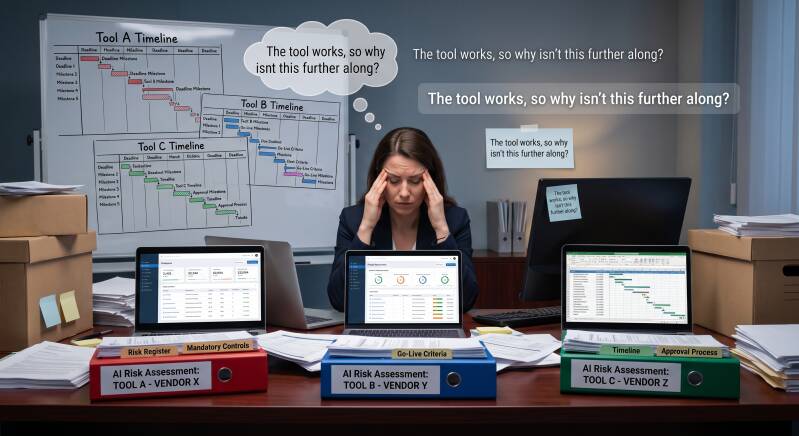
I currently sit on three different AI risk assessments at once, for three different tools — each with its own risk register, its own mandatory controls, its own go-live criteria. Three tools, three vendors, three timelines, and underneath all of them, the exact same conversation happening on repeat: the tool works, so why isn't this further along?
That question is the whole essay. So let's start there.
Every leadership team has an AI story now.
There's an innovation lab experimenting with copilots. A team piloting an automation workflow. A handful of employees quietly discovering use cases faster than anyone can document them. Vendors demoing capabilities at a pace nobody can honestly keep up with.
From the outside, it looks like acceleration.
From the inside, it looks like something else: an organisation that has gotten very good at running AI pilots, and not much closer to actually operating AI at scale.
That distinction is doing a lot of work, so it's worth sitting with. A pilot proves something is possible. Operations proves something is valuable. Most organisations are excellent at the first and have barely started the second — and mistake enthusiasm for progress on both.

The Experimentation Trap
The first phase of AI transformation is deceptively easy. A small group of enthusiastic employees starts using a new tool. They find efficiencies. Leaders hear the stories in a town hall and repeat them in the next board deck. Everyone agrees productivity is "clearly" improving.
Then, quietly, it stalls.
Not because the technology failed. Because the organisation was never built to operationalise it in the first place. The hard questions were never asked, and now they can't be avoided:
- How do we measure adoption, not just anecdotes about it?
- How do we govern usage once it's everywhere and no longer novel?
- How do we train people consistently instead of letting fluency stay a personality trait?
- How do we protect data once the tool is embedded in real workflows?
- How do we prioritise use cases instead of chasing whichever one got the most excited Slack messages?
- How do we prove business value to someone who wasn't in the room for the demo?
This is the part nobody puts on a slide: technology turns out to be the easy problem. Everything after it is organisational.

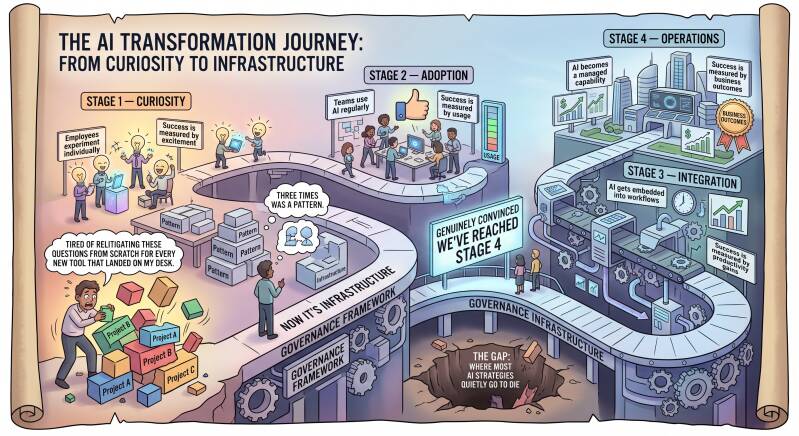
I built a governance framework for my own tool portfolio specifically because I got tired of relitigating these questions from scratch for every new tool that landed on my desk. Once was a project. Three times was a pattern. Now it's infrastructure.
The Four Stages of AI Maturity
Stage 1 — Curiosity. Employees experiment individually. Success is measured by excitement.
Stage 2 — Adoption. Teams use AI regularly. Success is measured by usage.
Stage 3 — Integration. AI gets embedded into workflows. Success is measured by productivity gains.
Stage 4 — Operations. AI becomes a managed capability. Success is measured by business outcomes.
Most organisations sit somewhere between Stage 1 and Stage 2, genuinely convinced they've reached Stage 4. That gap between where you are and where you think you are is where most AI strategies quietly go to die.
The Shift Leaders Must Make
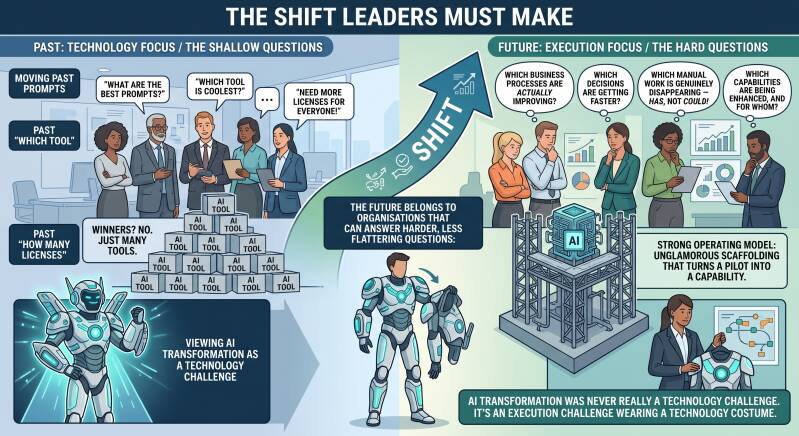
The conversation has to move past prompts. Past "which tool." Past "how many licenses." The future belongs to organisations that can answer harder, less flattering questions:
Which business processes are actually improving? Which decisions are getting faster? Which manual work is genuinely disappearing — not "could" disappear, but has? Which capabilities are being enhanced, and for whom?
The winners here won't be the organisations with the most AI tools. They'll be the ones with the strongest operating model wrapped around AI — the unglamorous scaffolding that turns a pilot into a capability.
Because AI transformation was never really a technology challenge. It's an execution challenge wearing a technology costume.
Reflection question: What percentage of your AI effort today is experimentation versus operationalisation? The honest answer probably tells you more about your transformation than any roadmap does. Mine wasn't flattering the first time I actually did the maths on it — worth doing before you assume yours will be.
Add comment
Comments