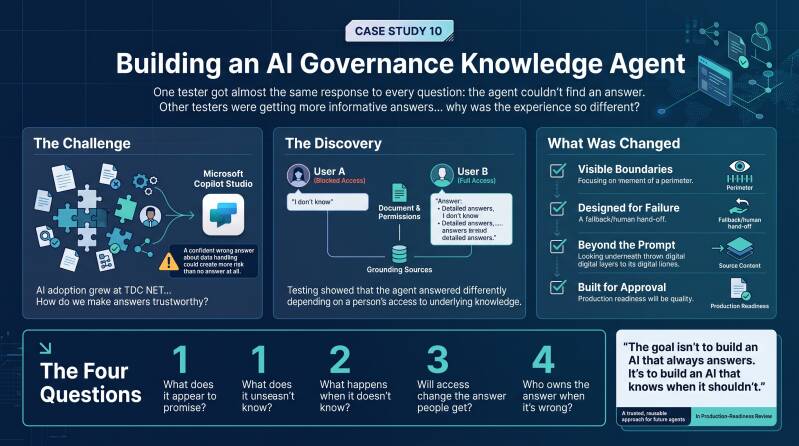
One tester got almost the same response to every question: the agent couldn’t find an answer.
Other testers were getting more informative answers to some of the same questions. It was the same agent, so why was the experience so different?
Working through that question changed how I thought about the whole product.
The Challenge
As AI adoption grew at TDC NET, employees needed practical answers about approved tools, responsible use, data handling, and where to go when they were unsure. The information existed, but it was spread across documents, processes, and subject-matter experts.
An agent built in Microsoft Copilot Studio could make that guidance easier to reach. But it would only help if people could trust the answers. A confident wrong answer about data handling could create more risk than no answer at all.
My Role
As Product Manager, I led the agent’s development, from its purpose and scope to the Copilot Studio build, governance documentation, user testing, and production readiness. My goal wasn’t just to show that an agent could answer questions, but to work out how one could responsibly become a trusted enterprise service.
Designing for Trust
I treated governance as a product requirement, not something to add at the end. That meant grounding answers in approved sources, defining what the agent was meant to answer, and designing a route to human expertise for when it couldn’t help.
What Testing Revealed
We tested everyday questions alongside difficult, ambiguous, and adversarial ones. But perhaps the most important technical finding wasn’t about a single question at all.
When one tester kept getting the generic response, the team traced it to an access issue involving document permissions. It showed something easy to miss in a demo: the same agent could answer the same question differently depending on a person’s access to the underlying knowledge source.
Testing also exposed a product risk: the agent could appear ready to help with topics its sources didn’t fully cover. One tester told me it wasn’t just answering their questions; it was showing where our own policies didn’t hold up. I went in testing the agent and ended up testing our governance too.
What I Changed
- Made the boundaries visible: The agent’s description of what it can help with now better matches what it knows.
- Designed for failure: Clearer fallback behaviour shows people when it can’t give reliable guidance, and points them towards human support.
- Looked beyond the prompt: Testing helped show which problems sat with the agent, and which came from source content or access to it. Gaps in the content went to guidance owners.
- Built for approval, not just a demo: I prepared the architecture and governance material needed for production review.
Results
- A working AI Governance Knowledge Center Agent in Microsoft Copilot Studio
- Specific gaps identified between what the agent appeared to offer and what its sources could support
- Document permissions identified as a factor in the answers people receive
- A reusable approach for future agents, covering governance documentation, knowledge grounding, adversarial testing, fallback design, and human escalation
Where It Stands
The agent is currently in production-readiness review.
What I Learned
Trust doesn’t come from an agent having an answer to everything. It comes from being clear about what it knows, honest about its limits, and able to hand people to a human when AI is no longer the right tool.
Before launching an internal agent, I’d now ask four questions: What does it appear to promise? What happens when it doesn’t know? Will access change the answer people get? Who owns the answer when it’s wrong?
The goal isn’t to build an AI that always answers. It’s to build an AI that knows when it shouldn’t.