At a glance
- My role: Product Manager and platform owner for Miro and Jira. I led the process redesign, governance, integration setup, and rollout.
- Organisation: Denmark’s largest telecoms infrastructure provider
- Tools: Miro, Jira
- Go-live: August 2026, timed for our quarterly planning
- Outcome: Quarterly planning outputs became Jira work the same day, each item linked to the board it came from.
The problem
Our teams were good at generating ideas and slow at turning them into work.
Product teams planned in Miro: discovery workshops, journey maps, roadmaps, and quarterly planning. Delivery teams worked in Jira: backlogs, sprints, and releases. Between them was a manual handoff. After every workshop, someone retyped the sticky notes as Jira issues, and that usually took two to three days.
The delay was only part of the cost. Each time work was copied, the reasoning behind it was lost. Developers got user stories without the discussion that shaped them. Stakeholders could see plans in Miro but not delivery progress in Jira. Tracing a delivered feature back to the decision that started it meant searching across two tools.
What I did
1. Mapped how work actually moved.
I interviewed stakeholders and ran process-mapping sessions to find where information was being recreated. It was happening at nearly every step from idea to delivery.
2. Fixed the process before connecting the tools.
Connecting two messy systems only gives you a faster mess. So I worked with the teams to agree on the basics first: who owns each work item, naming conventions, what a finished planning artifact looks like, and what traceability we needed.
3. Set up the integration.
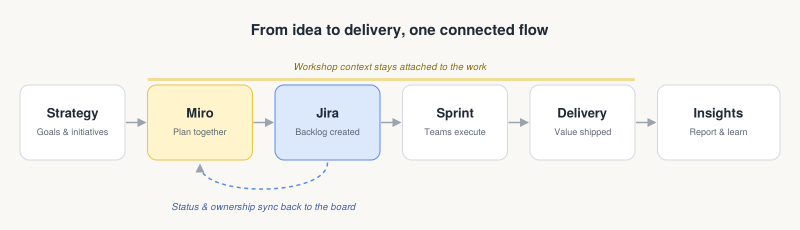
Teams now create Jira Epics, Features, Stories, and Tasks directly from a Miro board. Status and ownership changes in Jira sync back to the board, so the plan reflects reality, and the workshop context stays attached to the work.
4. Made it part of how people work.
I wrote a user guide, ran training sessions and delivery-team workshops, and built a champion network. We timed go-live for our August quarterly planning so teams learned the integration on real work, not a demo.
What changed in the first planning cycle
BeforeAfterWorkshop to executable backlog2–3 daysSame dayManual backlog creationRetyped by handAround 70% less effort*TraceabilityScattered across two toolsEvery item created in planning links to its Miro sourceStakeholder visibilityAsk for a status updateLive status on the planning board
Product owners stopped retyping and went back to product work. Engineers could see why they were building something, not just what. Leadership could follow an initiative from the whiteboard to delivery without asking anyone for a report.
These are early results from one planning cycle. Next I’ll track whether the time savings hold over the coming quarters and how far traceability reaches into delivered releases.
What I learned
- Process before technology. Most of the value came from redesigning the workflow. The integration made the new workflow possible.
- Context is what matters most. Moving data between systems is easy. Keeping the reasoning attached to the work is what improves decisions later.
- Adoption is the outcome. An integration nobody uses delivers nothing, so training and real use cases mattered as much as the setup.
- Traceability builds trust. When people can follow an idea all the way to delivery, they trust the process.
Digital transformation isn’t about connecting tools. It’s about removing friction between thinking and doing.